
In 1893, a year of financial depression in San Francisco, M. H. de Young, publisher of the San Francisco Chronicle, decided that the West was in need of its own world's fair. As National Commissioner at large attending the Columbian Exposition in Chicago in 1893, de Young began to rally public enthusiasm at home. Upon his return he lobbied until the Golden Gate Park Commission granted Concert Valley for the exposition, under the condition that the area be returned to the city in such a state that permanent improvements could be carried out on the land. Only five months after the ground breaking the California Midwinter International Exposition opened on 2 January 1894 in Golden Gate Park in San Francisco.
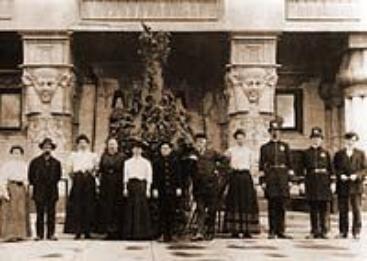
Exhibitors at the fair had been asked to adhere to exotic eastern themes to
contrast with the classical themes of the Columbian Exposition and to remind
visitors that California, even in January was another exotic land of sunshine.
Over 1,300,000 visitors in five months came to see the buildings laid out on
the leveled sand hills of the park. When the fair closed on 4 July, despite the
economic depression a profit of $126,991 had been made. The subject of starting
a permanent museum in Golden Gate Park as a memorial to the exposition was a
popular one in the press, so the Executive Committee of the fair, led by M. H.
de Young, offered the Fine Arts building to the Park Commissioners, together
with the surplus funds, for this purpose. After an initial reluctance the
commissioners accepted. Thus, the first structure for the Memorial Museum, its
link with an established world of culture from which it was separated by an
ocean and a great continent, was in the Egyptian Revival style, adorned with
images of Hathor the cow goddess.
The new Memorial Museum was a success from its opening 24 March 1895. No
admission was charged, and most of what was on display had been acquired from
the exhibits at the exposition, but de Young immediately began his own program
of acquisitions. When he began acquiring objects for the museum, he found he
had a lot to learn. At Tiffany's in New York he coveted a collection of an tique
knives and forks that he described as going back almost to Adam and Eve.
Shocked at their price, he was told that he "didn't understand the museum
game." Upon learning that part of what he was being asked to pay for was
the years and expertise invested in bringing together the individual elements
of the collection, de Young determined he would build his own. During the next
twenty years his taste for the curious, intricate, and ornamental was reflected
by acquisitions of painting and sculpture, arms and armor, fine porcelain,
objects from South Pacific and American Indian cultures, including original art
objects as well as reproductions. Visitors to the museum seem to have shared de
Young's interest in such diverse objects as sculptures, polished tree slabs,
paintings, a door reputedly from Newgate Prison, birds' eggs, handcuffs and
thumbscrews, as well as two cases de Young had at last filled with a collection
of knives and forks. Six thousand persons viewing the exhibits on a Sunday was
considered not at all out of the ordinary.
tique
knives and forks that he described as going back almost to Adam and Eve.
Shocked at their price, he was told that he "didn't understand the museum
game." Upon learning that part of what he was being asked to pay for was
the years and expertise invested in bringing together the individual elements
of the collection, de Young determined he would build his own. During the next
twenty years his taste for the curious, intricate, and ornamental was reflected
by acquisitions of painting and sculpture, arms and armor, fine porcelain,
objects from South Pacific and American Indian cultures, including original art
objects as well as reproductions. Visitors to the museum seem to have shared de
Young's interest in such diverse objects as sculptures, polished tree slabs,
paintings, a door reputedly from Newgate Prison, birds' eggs, handcuffs and
thumbscrews, as well as two cases de Young had at last filled with a collection
of knives and forks. Six thousand persons viewing the exhibits on a Sunday was
considered not at all out of the ordinary.
Although de Young's interests were admittedly eclectic, it is nevertheless true
that important objects in the Museums' permanent collections were acquired in
the early days of the Memorial Museum's existence. Gustave Dore's Poeme de la
vigne, known popularly as "The Dore Vase," was acquired from the
exposition and is still part of the permanent collection of The Fine Arts
Museums of San Francisco. The vase stands eleven feet high and twenty-two feet
in circumference, the figures on its surface entwining in grape leaves that
cascade down the swelling sides of six thousand pounds of cast bronze.
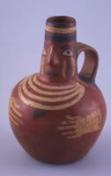
Important objects in the collection of ancient art and the art from Africa,
Oceania, and the Americas also entered the museum in these early days, much of
the latter coming from the collection of the museum's first curator, Charles P.
Wilcomb. One of de Young's early acquisitions, John Vanderlyn's painting Marius
Amidst the Ruins of Carthage, is the work around which the collection of
American art was subsequently built.
Before long the museum outgrew its buildings. De Young responded by planning
the building that today is familiar to de Young Museum visitors. Louis
Christian Mulgardt, the coordinator for architecture for the 1915
Panama-Pacific Exposition, designed the new Spanish Plateresque-style building
that was completed in 1919 and formally transferred by de Young to the city's
Park Commissioners. In 1921 de Young added a central section, together with the
familiar tower, and the museum began to assume its present configuration. That
year M. H. de Young's great efforts were honored when the museum's name was
changed to the M. H. de Young Memorial Museum. Yet another addition, a west
wing, was completed in 1925, the year de Young died.
The resemblance to the present building was only partial, however, as the
museum was encrusted with elaborate cast concrete decorations. The original
Egyptian building was declared unsafe and demolished in 1929, and only twenty
years later the concrete ornamentation of the de Young was called a hazard and
removed, the salt air from the Pacific having rusted the supporting steel.
Today a scattering of palm trees offsets the plain stucco facade of the museum
that faces the Music Concourse and the California Academy of Sciences.
The two museums that had been deeded to the City of San Francisco by their
founders had, under the city's administration, shared directors during the
thirties, though no official merger took place at that time. The Legion's first
official director was Cornelia Bentley Sage Quinton. She was followed in 1930
by Lloyd L. Rollins who, during his three-year tenure, also assumed the
directorship of the de Young Museum. Walter Heil came in 1933 and continued the
dual directorship until 1939. That year Thomas Carr Howe, who had been an
assistant director at the Legion since 1931, became its director, and Heil
continued to guide the progress of the de Young until his retirement in 1961.
 The
de Young's collection remained one of immense variety, even up to the time of
the opening in 1931 of a new unit that replaced the demolished Egyptian
building. Walter Heil, director of the de Young from 1933 until his retirement
in 1961, was responsible for the decision to focus the de Young's collecting
policies and create a comprehensive museum of fine and decorative art. His
predecessor, Lloyd Rollins, had begun to refine the collections; in furthering
that process Dr. Heil chose to tactfully refuse personal keepsakes and
household bric-a-brac, ending any perception of the de Young as the city's
attic.
The
de Young's collection remained one of immense variety, even up to the time of
the opening in 1931 of a new unit that replaced the demolished Egyptian
building. Walter Heil, director of the de Young from 1933 until his retirement
in 1961, was responsible for the decision to focus the de Young's collecting
policies and create a comprehensive museum of fine and decorative art. His
predecessor, Lloyd Rollins, had begun to refine the collections; in furthering
that process Dr. Heil chose to tactfully refuse personal keepsakes and
household bric-a-brac, ending any perception of the de Young as the city's
attic.
In the 1950s the de Young received a major gift from the Kress Collection. The
de Young was able to acquire such masterworks as St. Francis Venerating the
Crucifix by El Greco and Pieter de Hooch's Interior with Mother and Children as
well as choice works by Salomon van Ruysdael, Luca di Tomme, Titian, and an
outstanding work by Giovanni Battista Tiepolo, The Triumph of Flora.
It was also through Heil that the de Young received a major collection, gifts
from Mr. and Mrs. Roscoe F. Oakes of San Francisco that over a period of years
filled five galleries, one of them an eighteenth-century period room. Among the
paintings in the Oakes collection are such works as Rubens's Portrait of Rogier
Clarisse and Gabriel Metsu's Woman Playing a Viola da Gamba. Hals, Van Dyck,
Gainsborough, Reynolds, and Raeburn are also represented. In addition, the
Oakeses provided a generous fund for art acquisition that continues to enrich
the museums.
In 1972, the de Young Memorial Museum and the California Palace of the Legion
of Honor merged to form The Fine Arts Museums of San Francisco. The merger was
ratified by a large majority of San Francisco voters. Ian McKibbin White was
appointed director of the newly formed institution. With the new organization,
the California Palace of the Legion of Honor was designated a museum featuring
the arts of France. Other national schools were to be represented at the M. H.
de Young Memorial Museum.
One of lan White's goals was the establishment of an important center of
American art. In 1973 The Fine Arts Museums became host to the West Coast Area
Center of the Archives of American Art, a bureau of the Smithsonian
Institution, now located adjacent to the library in the de Young Museum. Four
years later, on 4 July 1973, the American Galleries were inaugurated, and in
January 1978 Mr. and Mrs. John D. Rockefeller 3rd announced their intention to
give the Museums more than one hundred works from their collection of American
art. Much of the collection came to the Museums in 1979, after Mr.
Rockefeller's death. Additional support arrived soon afterward when Mrs. Ednah
Root offered to fund a curatorial chair in American art.
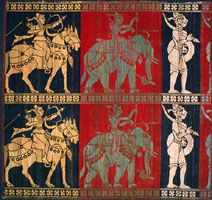
Another area of the Museums' collections grew impressively when H. McCoy Jones
placed in the Museums his collection of more than five hundred rugs, carpets,
and embroideries from the Near East and Central Asia. The surprise bequest of
Teotihuacan murals from the Harald Wagner Estate enriched the collections of
art from Africa, Oceania, and the Americas.
|
Copyright © 2003 Fine Arts
Museums of San Francisco |
|
|