
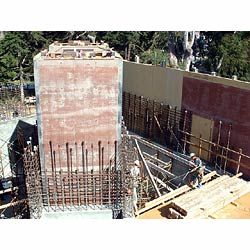
The decision was made at the beginning of Construction Documents to phase both the
CD's and Construction. This decision was made jointly by the Owner, Prime Architect,
Construction Manager, and City of San Francisco due to a number of factors:
CITY REQUEST
San Francisco's Department of Buildings requested that the permit set be issued in a series of packages to allow city
officials to manage the review process.
SCHEDULE
COFAM needed to maintain their originally-projected construction completion date in order to limit the extensive "soft"
costs associated with storage and administration of their vast art collection. Swinerton Builders recommended that drawing
packages involving materials and processes with long lead times be issued in advance of other packages to maintain this
completion date. Swinterton further advised the team that several large state projects (which the contractor was involved with)
were going to bid in the near future and that it would be necessary to bid the de Young quickly so as to get the project's steel
order to the mill.
COST / INFLATION
Rising construction costs, due to a booming economy, during the late-1990's put pressure on COFAM to move quickly. Unless
the Museum began construction on time, COFAM feared that the 5-7% annual inflation rate of construction costs would drive
the Museum's budget beyond the scope for which COFAM could raise funds.
POLITICAL MOMENTUM
COFAM felt the need to project the public image that the Museum's design and construction were proceeding without
impediment. The project eventually developed considerable public support. Because the Museum was such a high-profile
project and was still receiving considerable criticism, the Museum's Board felt that any display of weakness could harm
their fundraising efforts.
DESIGN EXCELLENCE
COFAM wanted to allow as much time during CD's to ensure Herzog & deMeuron's design intent was maintained and that
Fong & Chan were able to live up to their reputation for providing extremely high-quality documents. The Owner realized
that the tight schedule would not allow this to happen, while maintaining the completion date, unless the project were phased.
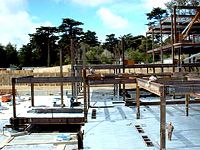
Construction Documents were broken down into several packages:
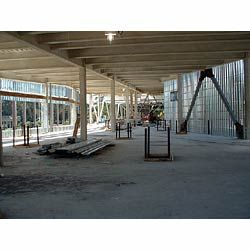
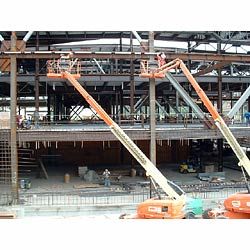
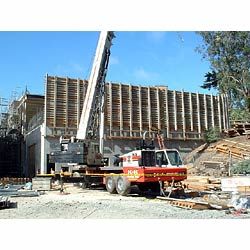
1. HAZARDOUS MATERIALS REMOVAL AND DEMOLITION (began late 2001, complete in early 2002). This process had to be
coordinated with the closing of the Museum, relocation of collections into long-term storage, and later closing of the Asian
Art Museum. The Asian Art Museum remained intact after the majority of the de Young was demolished so that the Asian's space
could be used as storage.
2. EXCAVATION AND SHORING (currently underway, mid-2002)
3. ISOLATION BEARING SYSTEM (prototype bearing in development and testing,
mid-2002)
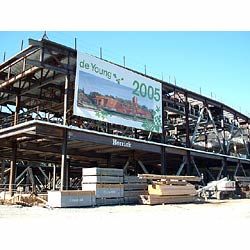
4. STRUCTURAL STEEL (bid returned to Fong & Chan on 9/27/02)